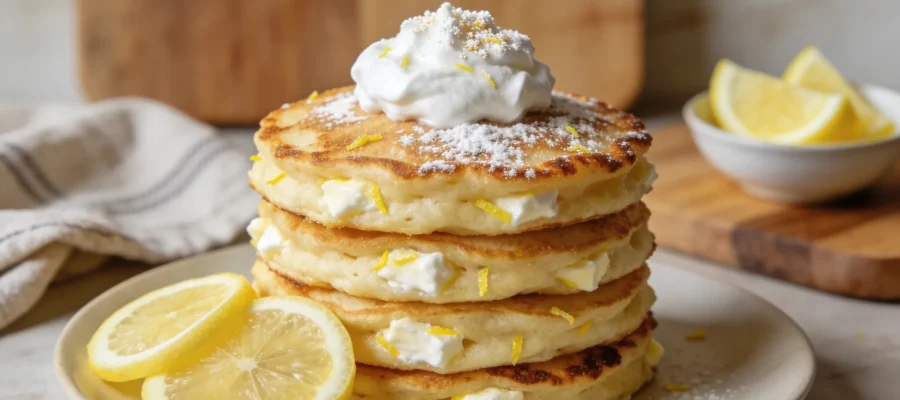
Lemon ricotta pancakes have completely changed my Sunday morning routine. I used to be firmly in the buttermilk pancake camp until a friend brought over a container of leftover ricotta and I had no idea what to do with it. That random fridge cleanout became the happy accident that led to these impossibly fluffy, protein-packed pancakes that somehow manage to taste indulgent while actually being reasonable calorie-wise. The first time I made them, they weren’t quite right—too dense and not lemony enough—but after some tinkering, I think I’ve nailed the balance.
Table of Contents :
Why These Lemon Ricotta Pancakes Are Worth Your Time
Let’s be real about pancakes for a second. Most of them are just vehicles for syrup—glorified carb discs that leave you hungry an hour later. I’ve made probably hundreds of batches over the years, and they’re usually good but forgettable. These are different.
The ricotta does something magical to the texture that’s hard to explain until you try it. They’re somehow both fluffy and substantial at the same time. I’ve served these to house guests who’ve literally asked me for the recipe before they’ve finished eating. My partner, who claims not to have a sweet tooth (lies), always steals at least one off my plate.
I did mess these up spectacularly the first couple of times. Once I mixed the batter too much and ended up with rubbery pancakes that bounced when I dropped them (not even exaggerating). Another time I used too much lemon and my 6-year-old nephew told me very solemnly that they tasted “like cleaning stuff” — kids really know how to humble you in the kitchen. But I promise, this version has been tested on both picky kids and judgmental adults, and it works.
Ingredients for Lemon Ricotta Pancakes
The beauty of these pancakes is that they’re made with pretty basic ingredients, but the combination creates something that feels special enough for company. The ricotta is obviously non-negotiable here, but there are a few places you can make substitutions if needed.
I’ve found that room temperature ingredients make a big difference with these pancakes. If you can, pull your eggs, milk, and even the ricotta out of the fridge about 30 minutes before you start mixing. Cold ingredients don’t incorporate as smoothly and can make the pancakes heavier.
Ricotta cheese (1 cup)
This is the star of the show and what gives these pancakes their signature texture. I use whole milk ricotta because the fat helps with tenderness, but I’ve made them with part-skim when that’s all I had, and they were still good—just slightly less rich. Look for ricotta that’s smooth rather than grainy. If yours seems watery, drain it in a fine-mesh sieve for about 20 minutes before measuring.
All-purpose flour (1 cup)
Regular all-purpose flour works perfectly here. I’ve tried using cake flour thinking it would make them even fluffier, but honestly couldn’t tell much difference. If you need to make these gluten-free, a 1:1 gluten-free flour blend works reasonably well, though they won’t rise quite as much.
Eggs (2 large)
Eggs provide structure and help bind everything together. They also contribute to the protein count, which is why these pancakes are more satisfying than standard ones. I’ve never tried making these with egg substitutes, so I can’t vouch for how that would turn out—the eggs are pretty important here.
Lemon (1 medium)
You’ll use both the zest and juice. The zest is where most of the aromatic oils live, so don’t skip that part! I use about 2 tablespoons of juice and the zest of one whole lemon, but you can adjust based on how lemony you want them. Meyer lemons work beautifully if you can find them—they’re a bit sweeter and less acidic.
Sugar (2 tablespoons)
Just enough to highlight the lemon flavor without making these overly sweet. I use regular granulated sugar, but I’ve substituted honey before with good results (use 1.5 tablespoons instead). If you’re watching sugar intake, you can reduce to 1 tablespoon—the ricotta has a natural sweetness that helps.
Baking powder (1 teaspoon)
This is what gives the pancakes their lift. Make sure yours is fresh—baking powder loses effectiveness after about 6 months. I learned this the hard way when I made these for Mother’s Day with baking powder from who-knows-when, and ended up with pancakes that were basically ricotta frisbees.
Milk (¼ cup)
I use 2% milk, but any dairy milk works well. The ricotta already adds richness, so you don’t necessarily need whole milk here. I’ve made these with almond milk in a pinch and while the texture was slightly different, they were still delicious. Buttermilk works too and adds a nice tang that plays well with the lemon.
Vanilla extract (½ teaspoon)
This might seem unnecessary with the lemon, but trust me—it rounds out the flavors perfectly. If you have vanilla bean paste, even better. I accidentally doubled the vanilla once and discovered it actually works really well if you want them to lean more toward dessert territory.
Salt (¼ teaspoon)
Just a pinch, but it’s crucial. Salt balances the sweetness and makes the lemon flavor pop. I use kosher salt, which has larger crystals than table salt. If you’re using table salt, reduce to ⅛ teaspoon.
Instructions for Lemon Ricotta Pancakes
These pancakes aren’t difficult, but they do require a bit more care than standard pancakes. The batter is thicker and more delicate because of the ricotta. The good news is that they’re actually harder to overcook than regular pancakes because the ricotta keeps them moist.
From start to finish, you’re looking at about 25 minutes if you’re organized (or 35 if you’re like me and constantly stopping to drink coffee and check your phone). The key with these pancakes is a gentle touch when mixing and medium-low heat when cooking. Too hot, and the outsides will brown before the centers set properly.
STEP 1: Prepare your lemon.
Zest the entire lemon first, being careful to get just the yellow part—the white pith underneath is bitter. Then juice the lemon—you’ll need about 2 tablespoons. I always zest directly onto a small plate rather than into the bowl, because there’s nothing worse than accidentally dumping way too much zest into your batter. If your lemon is cold from the refrigerator, roll it firmly on the counter before juicing to get more juice out.
STEP 2: Mix the wet ingredients.
In a large bowl, combine the ricotta, eggs, lemon juice, lemon zest, milk, and vanilla. Whisk until smooth, but don’t go crazy with the mixing—you want everything incorporated but not beaten to death. The mixture should look a bit lumpy because of the ricotta, and that’s exactly what you want. I once used an electric mixer thinking it would be better and ended up with pancakes that had the texture of rubber.
STEP 3: Combine the dry ingredients.
In a separate bowl, whisk together the flour, sugar, baking powder, and salt. Again, just a quick mix to distribute everything evenly. I used to skip this step and add the dry ingredients directly to the wet, but found that the baking powder and salt didn’t distribute evenly that way. Learned that lesson after biting into a pancake and getting a pocket of baking powder—not recommended.
STEP 4: Create the batter.
Add the dry ingredients to the wet ingredients and gently fold together using a rubber spatula. This is the most crucial step—mix JUST until combined. You’ll still see some small lumps, and the batter will be thick and somewhat fluffy. If you overmix, you’ll develop the gluten in the flour and end up with tough pancakes. Stop mixing as soon as you don’t see dry flour anymore. The batter should fall slowly from your spatula, not run off in a thin stream.
STEP 5: Rest the batter.
Let the batter rest for 5-10 minutes. I know you’re hungry and want to start cooking immediately (I’ve been there!), but this rest time lets the gluten relax and the baking powder start working. I make my coffee during this time to keep myself from getting impatient. If the batter seems too thick after resting, you can add a tablespoon of milk to thin it slightly, but it should be thicker than regular pancake batter.
STEP 6: Heat your pan or griddle.
While the batter is resting, heat a non-stick pan or griddle over medium-low heat. This is lower than you might normally cook pancakes, but these need a gentler touch because of their higher sugar content (they’ll brown faster). To test if the pan is ready, flick a few drops of water on it—they should dance around but not immediately evaporate. I like to lightly grease the surface with butter, wiping off excess with a paper towel. Too much fat and the pancakes won’t brown properly.
STEP 7: Cook the pancakes.
Use a ¼ cup measure to scoop the batter onto your heated pan. These won’t spread as much as regular pancakes, so I use the back of the measuring cup to gently spread the batter into a circle about 4 inches wide. Cook until you see tiny bubbles forming on the surface and the edges look set, about 2-3 minutes. They won’t bubble as dramatically as regular pancakes because of the ricotta, so don’t wait too long or they’ll burn.
STEP 8: Flip and finish cooking.
Carefully flip the pancakes—they’re more delicate than regular pancakes so use a thin spatula and be decisive with your flip. Cook for another 1-2 minutes on the second side until golden brown and cooked through. The center should spring back slightly when touched. Transfer to a warm plate and repeat with remaining batter. If your first pancake comes out too dark, lower the heat a bit. These pancakes should be a lovely golden color, not dark brown.
Tips & Variations for Lemon Ricotta Pancakes
These pancakes are actually at their best served immediately, but if you need to keep them warm while cooking the rest, place them in a single layer on a baking sheet in a 200°F oven. Stacking them while hot can make them soggy. Leftovers can be refrigerated for 2 days and reheated in a toaster or skillet, though they won’t be quite as fluffy.
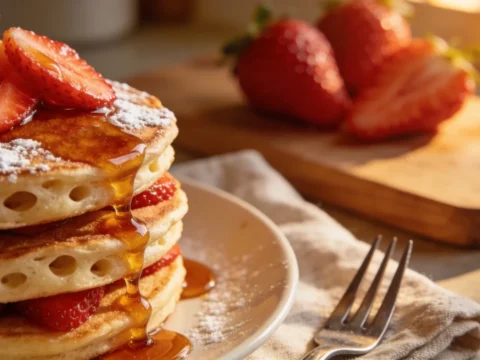
Want to switch things up? Add fresh blueberries to the batter (fold them in gently after mixing) or top with sliced strawberries. For a more decadent version, add a handful of white chocolate chips. And if lemon isn’t your thing, orange zest and juice works beautifully too. The ricotta itself is mild enough to pair with almost any flavor.
For a quick blueberry compote, simmer 1 cup of blueberries with 2 tablespoons of maple syrup and a squeeze of lemon juice for about 5 minutes until the berries start to burst. It’s the perfect topping and takes almost no effort.
Final Thoughts on Lemon Ricotta Pancakes
Look, I’m not going to claim these are the most authentic Italian-style ricotta pancakes or some kind of gourmet masterpiece. What they are is a really reliable, surprisingly simple upgrade to your standard pancake that somehow manages to feel special without requiring special skills or ingredients.
If you try these, let me know how they turn out. Seriously, I’m always curious if other people’s batches come out like mine or if my kitchen is just weirdly calibrated. And if you discover any variations that work well, I’d love to hear about those too. Happy breakfast-ing!
Lemon Ricotta Pancakes
These lemon ricotta pancakes are fluffy, protein-packed, and a delightful upgrade to your standard pancake recipe. They're perfect for a special breakfast or brunch.