Low calorie chia pudding has become my breakfast lifesaver on busy mornings when I need something that won’t weigh me down but will actually keep me full past 10am. After years of disappointing store-bought versions that either tasted like cardboard or packed in hidden sugars, I finally cracked the code on making a homemade version that’s genuinely satisfying while keeping the calories in check. The best part? It literally makes itself overnight while you sleep.
Table of Contents :
Why I’m Obsessed With This Low Calorie Chia Pudding
Look, I was skeptical about chia pudding for the longest time. Those little seeds that expand into a weird gel texture? Not exactly selling itself. My first attempt was a complete disaster – I didn’t use enough liquid and ended up with something resembling concrete that could probably withstand nuclear fallout. The second time wasn’t much better because I overcorrected with too much liquid and got chia soup instead.
But I kept at it because I needed something I could grab on rushed mornings that wouldn’t derail my calorie goals. After about six different iterations (and one memorable version where I accidentally used way too much vanilla and it tasted like I was eating perfume), I finally nailed the proportions that create that perfect pudding-like consistency while keeping it under 200 calories per serving.
My husband, who generally regards “health food” with deep suspicion, actually started stealing my batches from the fridge. That’s when I knew this recipe was a keeper. The secret to making this low calorie version work is using unsweetened almond milk as the base and controlling added sweeteners, while still keeping enough flavor that you don’t feel like you’re eating diet food.
Ingredients for low calorie chia pudding
The beauty of this recipe is its simplicity. You only need a handful of ingredients, most of which you probably already have in your pantry. What makes this version specifically “low calorie” is being intentional about which milk you choose and how you add sweetness without going overboard.
I’ve tested this with pretty much every milk alternative out there, and while oat milk makes a creamier pudding, it also adds significantly more calories. Same goes for coconut milk, which tastes amazing but defeats the “low calorie” purpose. Here’s what I’ve found works best:
Chia seeds (3 tablespoons)
These tiny powerhouses are the star of the show. They contain healthy omega-3 fatty acids and pack in fiber that keeps you full. Don’t try to substitute flax seeds here – I tried once in desperation when I ran out of chia, and ended up with a slimy mess that wasn’t remotely pudding-like. The brand doesn’t matter much, but make sure they’re not expired as old chia seeds don’t gel properly.
Unsweetened almond milk (1 cup)
This is your low-calorie liquid base at only about 30 calories per cup. I’ve tried this with regular milk, which works texture-wise but adds about 100 extra calories. Cashew milk is another good low-cal option if you’re not an almond fan. Whatever you do, don’t use rice milk – I made this mistake once and it was way too thin.
Maple syrup (1 teaspoon)
Just enough sweetness without going overboard on calories. Honey works too, though it has a stronger flavor. I tried stevia drops once and regretted it immediately – there was a weird aftertaste that no amount of cinnamon could mask. If you’re really watching calories, you can reduce this to ½ teaspoon, but don’t skip it entirely or it’ll taste too bland.
Vanilla extract (¼ teaspoon)
This tiny amount adds tremendous depth of flavor without adding calories. I once accidentally poured in a full tablespoon (while half-asleep) and it was overpowering, so stick to this small amount. The real stuff is worth it here – the artificial vanilla just doesn’t give the same warmth.
Ground cinnamon (¼ teaspoon)
This is my secret weapon for making low-calorie foods taste more satisfying. It adds a natural sweetness without any actual sugar. It’s optional but highly recommended. I’ve tried nutmeg too, which is nice but much stronger – use just a tiny pinch if you go that route.
Pinch of salt
Don’t skip this! I forgot it once and the pudding tasted flat and one-dimensional. Salt enhances sweetness, which means you can use less maple syrup. It’s literally just a tiny pinch, but it makes all the difference between “meh” and “wow.”
Instructions for low calorie chia pudding
The beauty of chia pudding is that it’s almost impossible to mess up once you know the right proportions. It’s more of an assembly job than actual cooking. That said, there are a few specific techniques that make the difference between perfectly smooth pudding and one where you get unexpected pockets of dry seeds.
You’ll need about 5 minutes of prep time in the evening, then the fridge does all the work overnight. If you’re new to chia pudding, don’t panic if it looks way too liquid-y at first – those seeds need time to work their magic. And yes, you really do need to stir it twice, which I learned the hard way after having to chew through clumps of dry seeds the first time I made this.
STEP 1: Combine all ingredients except the chia seeds.
In a mason jar or container with a tight-fitting lid, pour in the cup of almond milk, then add the maple syrup, vanilla extract, cinnamon, and pinch of salt. Close the lid and give it a good shake to blend everything. Why do this first? I’ve found that if you add the chia seeds at the same time, they start absorbing liquid immediately and can clump before everything’s mixed. Trust me, fishing out chia clumps at 6am is not how you want to start your day.
STEP 2: Add the chia seeds and shake vigorously.
Once your liquid is mixed, open the jar and add the 3 tablespoons of chia seeds. Seal it tightly and shake like your life depends on it for about 30 seconds. You’ll see the seeds starting to distribute throughout the liquid. If you’re using a bowl instead of a jar, whisk thoroughly with a fork. The mixture will still look very liquid at this point – that’s normal. Don’t panic and add more seeds or you’ll end up with chia concrete (ask me how I know).
STEP 3: Let it rest, then shake again.
This is the step most recipes don’t mention, but it’s critical. Put the jar in the fridge and set a timer for 15 minutes. During this time, the seeds will start to absorb liquid and can stick together. After 15 minutes, take it out and shake vigorously again to break up any clumps that are forming. This second shake makes all the difference between smooth pudding and weird clumpy pudding. I used to skip this step until I bit into a dry pocket of seeds one morning – lesson learned.
STEP 4: Refrigerate overnight (or at least 4 hours).
After that second shake, return the jar to the fridge and let it sit overnight. The minimum time is really about 4 hours, but overnight gives the best texture. The first time I made this, I got impatient and checked it after an hour – it was still basically chia soup. By morning, though, it magically transforms into a thick, pudding-like consistency. The chia seeds absorb the liquid and create that signature gel-like texture that makes it satisfying despite being low calorie.
STEP 5: Give one final stir before serving.
In the morning, open your jar and give the pudding one final stir with a spoon. Sometimes the seeds at the bottom absorb slightly more liquid, so this evens everything out. If it seems too thick, you can add a splash more almond milk and stir. If it’s too thin (which can happen if your chia seeds are older), you can either add a few more seeds and wait another 15 minutes, or just enjoy it as is – it’ll still taste good even if the texture isn’t perfect.
Tips & Variations for low calorie chia pudding
This basic low calorie chia pudding keeps well in the fridge for up to 4 days, which makes it perfect for meal prep. The texture actually improves after that first day as the flavors meld together. If it thickens too much over time, just add a splash of almond milk before eating.
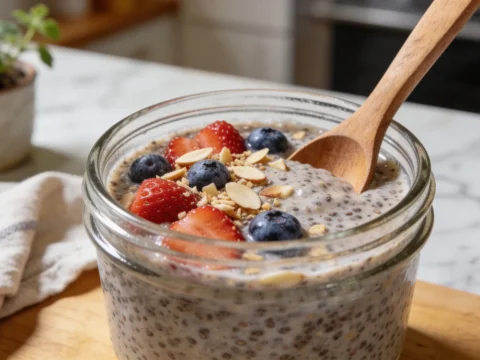
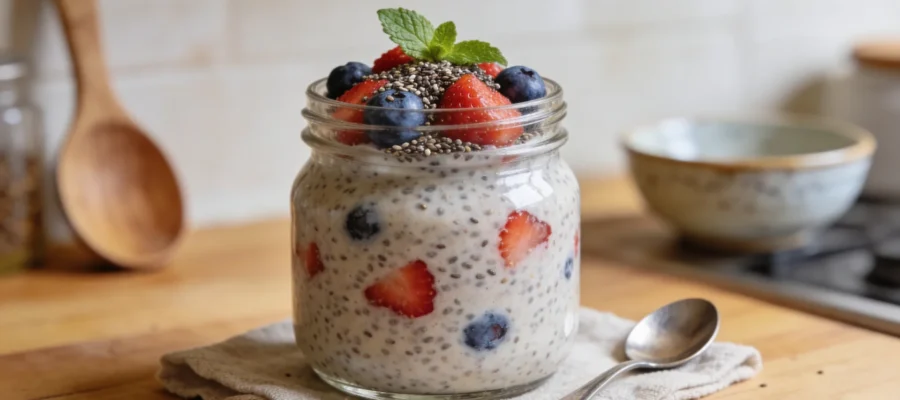
For toppings that won’t break the calorie bank, fresh berries are my go-to – especially raspberries or sliced strawberries. A teaspoon of unsweetened cocoa powder whisked in with the liquid ingredients makes a chocolate version for about 10 extra calories. For an autumn twist, try pumpkin spice instead of cinnamon and add a tablespoon of pumpkin puree (adds about 5 calories).
One more thing: real homemade chia pudding never looks as perfectly uniform as those Instagram photos. Mine always has a slight mottled appearance where the seeds are visible, and that’s completely normal. If yours doesn’t look like a professional food stylist made it, you’re actually doing it right.
Final Thoughts on low calorie chia pudding
This low calorie chia pudding has saved me from so many sad desk breakfasts and hangry mid-morning snack runs. It’s not going to win any gourmet cooking awards, but it’s genuinely satisfying in a way that most low-calorie breakfasts aren’t. The best part is that it’s practically foolproof once you get the proportions right.
If you try this recipe, drop a comment about your favorite flavor combinations. I’m always looking for new variations to keep breakfast interesting without spending half my morning in the kitchen or half my daily calories before 9am!
Low Calorie Chia Pudding
A homemade low calorie chia pudding that is light, filling, and prepped overnight. Perfect for busy mornings, keeping you full while being under 200 calories per serving.