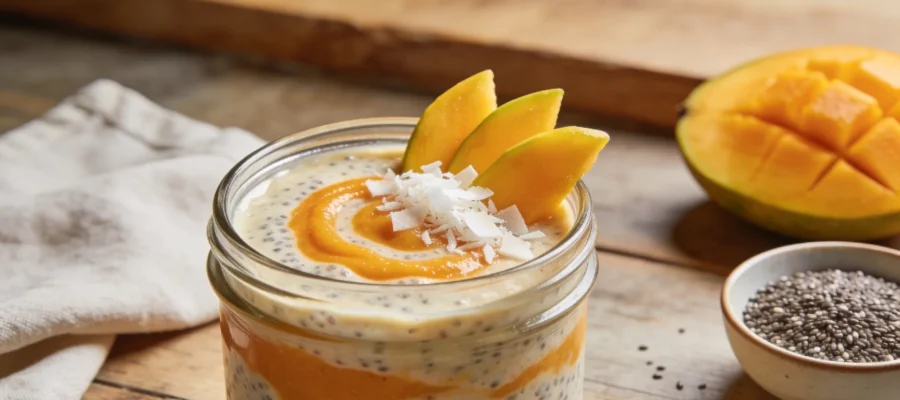
This mango chia pudding recipe honestly changed my breakfast game forever. I’ve been making it weekly for months now, and I’m still not tired of waking up to that creamy, tropical goodness waiting in the fridge. It’s ridiculously simple—just 5 minutes of actual work—but somehow feels like a fancy treat that should take way more effort. The best part? It’s naturally dairy-free and packed with good stuff, but tastes like dessert for breakfast.
Table of Contents :
My Journey to the Perfect Tropical Breakfast
Let me be completely honest—I used to be super skeptical about chia pudding. The first time I tried making it, I ended up with something that looked like frog spawn sitting in watery milk. Not appetizing. I almost gave up on the whole concept until my friend brought some mango chia pudding to a brunch, and I couldn’t believe it was the same dish.
The secret, I learned after three more failed attempts, was getting the liquid-to-chia ratio right. Too much liquid and you’ve got sad chia soup; too little and it’s weirdly gummy. And don’t even get me started on the time I used pre-packaged mango chunks that had zero flavor—lesson learned. Fresh, ripe mangoes are non-negotiable here, or at the very least, frozen mango that was actually ripe when frozen. The difference is night and day.
After much trial and error (and forcing my poor husband to eat all my experiments), this recipe nails that perfect thick, pudding-like consistency with bright tropical flavor that makes you feel like you’re somewhere with palm trees, even when you’re just at your kitchen table on a Tuesday.
Ingredients mango chia pudding recipe
The beauty of this recipe is its simplicity, but that also means the quality of each ingredient matters more. I’ve learned that skimping on the mango or using a low-quality coconut milk makes a massive difference in the final result. Trust me, I’ve made all these mistakes so you don’t have to.
This isn’t a recipe where you need fancy equipment or specialty items—everything should be available at most grocery stores. That said, I do have some strong opinions about what works best:
Ripe Mango (1 large or 2 small, about 1½ cups diced)
The star of the show needs to be perfectly ripe—slightly soft to the touch with that heavenly sweet aroma. Ataulfo (honey) mangoes are my favorite for their creamy texture and intense flavor, but Kent or Tommy Atkins work too. If you can’t find good fresh ones, frozen mango chunks are your next best option. Just thaw them completely first.
Chia Seeds (¼ cup)
These magical little seeds create the pudding texture by absorbing liquid and creating a gel-like consistency. Black or white chia seeds work equally well—there’s no flavor difference. I buy mine in bulk because I use them so much, but any brand will do. Just check they’re not expired, as old chia seeds don’t gel as well.
Coconut Milk (1 can, about 13.5 oz)
Full-fat coconut milk gives the creamiest result—I learned the hard way that light versions make a thinner pudding. Look for brands without additives or gums if possible (Thai Kitchen is reliable). Shake the can well before opening, or better yet, empty into a bowl and whisk until smooth if you notice any separation.
Maple Syrup (2-3 tablespoons)
Real maple syrup provides the perfect sweetness without overpowering the mango. Honey works as a substitute but changes the flavor profile slightly. I usually start with 2 tablespoons and add more after tasting, since the natural sweetness of your mango will vary. Agave nectar works too if that’s what you have.
Vanilla Extract (1 teaspoon)
A little vanilla rounds out the tropical flavors beautifully. I use pure vanilla extract, not the imitation stuff which can leave an artificial aftertaste. You could substitute half a vanilla bean scraped if you’re feeling fancy, or leave it out entirely if you don’t have any—the pudding will still be delicious.
Lime Juice (1 tablespoon)
This brightens everything up and balances the sweetness. The acid in the lime also helps preserve the mango’s color. Fresh is definitely better than bottled here. In a pinch, lemon juice works, but you’ll miss that tropical vibe that lime brings to the party.
Pinch of Salt
Don’t skip this! A tiny pinch of salt makes all the other flavors pop. I use fine sea salt, but regular table salt works fine. It seems weird in a sweet recipe, but I promise you won’t taste “saltiness”—it just makes the mango and coconut flavors more vibrant.
Instructions mango chia pudding recipe
Despite how fancy it might look, this mango chia pudding recipe is actually pretty foolproof once you know the basic technique. The active prep time is maybe 5-10 minutes, then the fridge does all the work while you sleep (or go about your day, but I like making it at night for breakfast the next morning).
One thing to know: the pudding needs at least 4 hours to set properly, but overnight (8+ hours) is ideal for the best texture. I’ve tried rushing it and eating it after just 2 hours, and while it was edible, the texture was definitely not there yet. Patience rewards you with that perfect creamy consistency.
STEP 1: Prepare your mango.
Peel and dice your mango, removing all the flesh from around the pit. You want about 1½ cups total. The first time I made this, I spent 10 minutes fighting with the mango and ended up with juice running down to my elbows. If you’re new to cutting mangoes, try scoring the flesh in a grid pattern while it’s still in the skin, then turn it inside out and slice off the cubes. So much easier.
STEP 2: Blend the mango mixture.
Add the diced mango, half the coconut milk (about ⅔ cup), maple syrup, vanilla, lime juice, and salt to a blender. Blend until completely smooth, about 30-45 seconds. Stop and scrape down the sides if needed. You’re looking for a thick, smoothie-like consistency with no chunks. I once under-blended this and had random mango fibers throughout my pudding—not the dreamy texture we’re after.
STEP 3: Mix with chia seeds.
Pour the mango puree into a medium bowl and whisk in the remaining coconut milk. Add the chia seeds and immediately whisk vigorously for a good 30 seconds. This is crucial—if you just stir briefly and walk away, the chia seeds will clump together in gelatinous lumps instead of distributing evenly. I learned this the hard way and had to fish out slimy chia clumps with a fork. Not fun.
STEP 4: Let it rest, then whisk again.
Let the mixture sit for about 10 minutes, then whisk again thoroughly. This second whisking is the secret to perfect consistency—the chia seeds start to gel slightly in those first 10 minutes, and re-whisking breaks up any early clumps. It takes just 30 seconds but makes a world of difference. I sometimes set a timer so I don’t forget this step.
STEP 5: Transfer to serving containers and chill.
Pour the mixture into individual jars or a larger storage container. I like using small mason jars or clear glasses if I’m serving guests—the vibrant yellow-orange color is too pretty to hide. Cover with lids or plastic wrap and refrigerate for at least 4 hours, but preferably overnight. The pudding will thicken significantly as it sits, transforming from liquid to a soft, spoonable texture.
STEP 6: Garnish and serve.
When ready to serve, give each portion a quick stir. If it’s too thick for your liking, you can thin it with a splash of coconut milk. I like topping mine with extra diced mango, a sprinkle of toasted coconut flakes, or even some chopped pistachios for crunch. A tiny squeeze of lime zest on top takes it to next-level freshness. The contrast between the creamy pudding and fresh mango pieces is *chef’s kiss*.
Tips & Variations mango chia pudding recipe
This pudding keeps beautifully in the fridge for up to 4 days, making it perfect for meal prep. The texture actually improves on the second day, in my opinion. If it thickens too much over time, just stir in a splash of coconut milk or even water to loosen it up.
For a less tropical version, almond milk or oat milk can substitute for coconut milk, though the pudding won’t be quite as rich. Want to make it more dessert-like? Fold in some whipped coconut cream just before serving.
And don’t feel limited to mango! The basic formula works with almost any pureed fruit—I’ve made incredible versions with strawberries, peaches, and blueberries. Just keep the ratio of about 1½ cups fruit puree to ¼ cup chia seeds and adjust the sweetener to taste.
If your pudding doesn’t look as vibrantly colored as mine in the photos, don’t worry! The natural color varies depending on the variety and ripeness of your mango. It’ll still taste amazing.
Final Thoughts mango chia pudding recipe
This mango chia pudding recipe has become my reliable go-to when I want something that feels special but requires minimal effort. It’s perfect for busy mornings, meal prep, or even entertaining—I’ve served it at brunch in pretty glasses and everyone asked for the recipe, assuming I’d spent hours in the kitchen. (I didn’t correct them.)
If you try making this, I’d love to hear how it turned out for you! Especially if you come up with your own flavor variations or topping combinations. There’s something so satisfying about starting your day with something this delicious that also happens to be good for you.
Tropical Mango Chia Pudding
This mango chia pudding recipe is thick, creamy, and dairy-free, providing a tropical flavor that feels like dessert for breakfast.